Mark McCloud's LSD Museum & the Two Trials That Nearly Cost Him Life Behind Bars

Photo: Haight Street Voice
In a timely weathered three-story Victorian house on 20th Street, San Francisco, behind drawn black curtains and a front door layered in subcultural stickers, hangs the largest collection of LSD blotter art in the world. Its curator, Mark McCloud, calls it the Institute of Illegal Images. This is the story of how an art collector faced the possibility of life in prison twice and walked out of the courthouse a free man each time.
Mark McCloud & His Blotter Art Collection
McCloud was born in Buenos Aires, Argentina and raised there until he was twelve, when he was sent to a boarding school in Claremont, California, arriving in the mid-1960s just as American counterculture was catching fire. He trained as an artist, earning an MFA from UC Davis, studied Renaissance art in Paris, and later went on to teach. For a decade, from 1977 to 1987, he served on the artist board of the San Francisco Art Institute, and over his career he won two grants from the National Endowment for the Arts, credentials that would later matter a great deal during his trial.
Mark McCloud's fascination with blotter came from both a love for psychedelics and a 1971 experience he recalls tripping on Nick Sand's Orange Sunshine LSD. McCloud describes accidentally falling from a window during this trip, causing him to have a profound experience of death then rebirth. He went on to collect blotter as a thank you to LSD, the substance he credits with saving his life that day.
He came to see the small, perforated squares of decorated blotter paper being used to carry acid not as drug paraphernalia at all, but as art, small pieces of history that should be preserved. Because the paper was illegal and generally consumed, almost no one was collecting it at the time. He began collecting on a smaller scale in the mid-1970s, initially storing sheets in his refrigerator and freezer, a strategy made difficult by the temptation to still eat the collection.
After buying his San Francisco home in 1983, he started framing the sheets and hanging them on his walls. Framing, he has said, changed everything: you can't swallow a piece of art behind glass. In 1987 he hosted the first gallery show of blotter art at the San Francisco Art Institute.

Photo: California Curiosities
Today the Institute of Illegal Images holds more than 33,000 blotter art sheets and individual acid tabs, with several hundred framed pieces displayed floor to ceiling across the museum walls. The designs are some of the most famous, from Mickey Mouse and Felix the Cat to Hindu deities, pyramids, flying saucers, Mikhail Gorbachev, and McCloud's own best-known creations. A crucial point to note with the whole collection: the older "street sheets" have been deliberately exposed to ultraviolet light and oxygen, which breaks down any LSD they may once have carried, allowing them to be legally preserved in the museum, and much of the collection consists of undipped paper that was collected but never held the drug at all.
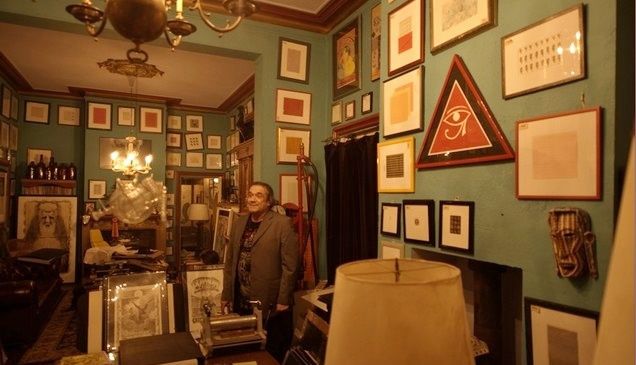
Photo: Mark McCloud / Institute of Illegal Images, via Atlas Obscura

Photo: Mark McCloud / Institute of Illegal Images
That question of art versus acid is exactly what two federal juries were eventually asked to decide.
Mark McCloud's first blotter trial: Houston, 1992
McCloud's first legal battle came in 1992, while he was exhibiting part of his collection in Houston, Texas. Federal authorities arrested him and charged him with conspiracy to distribute LSD, essentially the theory that his blotter art was intended for the drug trade rather than a genuine art collection.
The case did not survive, with no real evidence provided by the government. By McCloud's account, the prosecution presented several days of testimony, and the judge granted an acquittal of all charges before the defense started its case. McCloud walked out a free man. He has said that from that point on he felt the drug-enforcement agencies had marked him, a claim found to be true, based on the surveillance and attempted setups that followed in the years afterward.
The first trial established an unfortunate cycle for McCloud: the government treating the sheer scale of the collection as evidence of an LSD kingpin, and McCloud continuing to insist he was an artist who made and collected paper, not a chemist who illegally dosed it. As he later put it, describing his own defense: he raises eggs, and it isn't his fault if some grow into bad chickens.
Mark McCloud's second blotter trial: Kansas City, 2000 to 2001
The second case was far bigger, far more expensive, and had far more on the line for McCloud.
It began, as these things often do, far from San Francisco. In the summer of 1999, an LSD bust in Des Moines, Iowa, led DEA agents to two men in the Waldo neighborhood of Kansas City, Missouri, Garen Armstrong and Matthew Skelly, caught with thousands of hits of acid. Facing decades in prison, they cooperated and named a supplier, who in turn led investigators up the chain to a woman named Kathleen Brown, and finally to a name in San Francisco: Mark.
That thread was enough to launch an extraordinary investigation. Federal agents again surveilled McCloud's home for roughly a year and a half, reportedly watching from neighboring apartments, tapping phones, and monitoring his mail. In early 2000, an FBI and DEA task force raided his home in a SWAT-style operation. In McCloud's backyard shed they found boxes of edible blotter paper and a perforation machine capable of turning a simple paper sheet into a perforated blotter; in the attic, more boxes of printed blotter. They seized roughly 400 framed blotters and some 33,000 sheets of McCloud's own paper. The first framed sheet taken from the wall was a large red blotter printed with the logo of the FBI, tagged as the first piece of evidence seized by the federal agents. Crucially, none of the seized material tested positive for LSD.
McCloud was charged with conspiracy to manufacture and distribute LSD. A conviction could carry a sentence of life in prison.

Photo: Gregory Thomas / Mission Local
The case was tried in Kansas City rather than San Francisco, this court chosen because dipped blotter linked to McCloud had turned up in a 1999 raid in this state, at a house the prosecution noted was near a school. That geography terrified the defense; McCloud worried a Midwestern jury would be far less receptive than a San Francisco one to the argument that acid blotter is a legitimate art form.
The trial opened on March 26, 2001, before U.S. District Judge Gary Fenner. The Assistant U.S. Attorney Mike Oliver argued that the museum was an elaborate cover, the perfect front, he told the jury, to distribute LSD across the country, with McCloud using his genuine education and reputation as an artist to disguise the operation. McCloud's San Francisco attorney, Doron Weinberg, countered that his client made and sold paper, and could not be held responsible for what other people later did with it, that art is not LSD, and the drug is only potentially added afterward, by someone else.
The defense leaned hard into the art argument. New York art critic Carlo McCormick testified that McCloud's work belonged to an American folk-art tradition; an editor from Paper magazine flew in to speak to his standing; and his two NEA grants and gallery history were placed before the jury.
After a roughly two-week trial, the jury could not reach a majority verdict. After some deliberating, they returned a verdict: not guilty.
McCloud reportedly leapt up to greet the jurors, earning a rebuke from the judge, and later thanked the people of Kansas City for being able to tell the difference between art and LSD.
His legal defense in the case is estimated to have cost more than half a million dollars.
Aftermath

Photo: Gregory Thomas / Mission Local
Acquitted twice, McCloud never stepped away from the blotter art world. He continues to run the Institute of Illegal Images, open by appointment, and sells enlarged (un-dosed) giclee prints of blotter art designs, and has published a book of blotter art designs and still collects blotters gathered from across the world to add to his collection.
The government once argued that a museum of illegal images was the perfect cover for a drug operation, but behind the black drawn curtains of his San Francisco home sits the most important figure in blotter art history: an enigmatic archivist whose blotter collection continues to preserve a mysterious underground art form.